
Introduction
Some cities make antiquing feel less like shopping and more like a genuine hunt. The right mix of age, estate sales, antique shops, and secondhand demand can turn a casual weekend browse into a real chance at uncovering something with history, craftsmanship, and lasting value.
To find the best places in the country for that kind of search, we analyzed data across 100 of the largest U.S. cities using 11 factors tied to antiquing potential.
The results highlight where hidden treasures may be easiest to find and what makes certain cities stand out from the rest. Notably, many of the highest-ranking cities cluster in older parts of the country, where long-established housing, estate turnover, and antique retail are more common.
From places with deep inventories and older infrastructure to cities where interest in secondhand shopping runs especially high, here’s what the data reveals about the best U.S. cities for antiquing.
The Best and Worst U.S. Cities for Antiquing
Finding a great antique isn’t just about luck. It also helps to be in a city where older homes, estate sales, antique shops, and secondhand retail all come together to create more chances for discovery.
In our ranking, cities earned the strongest scores when they paired a deep bench of antique stores and estate sales with the kind of older housing stock that often signals a longer history of goods changing hands over time.
The Best Cities for Antiquing
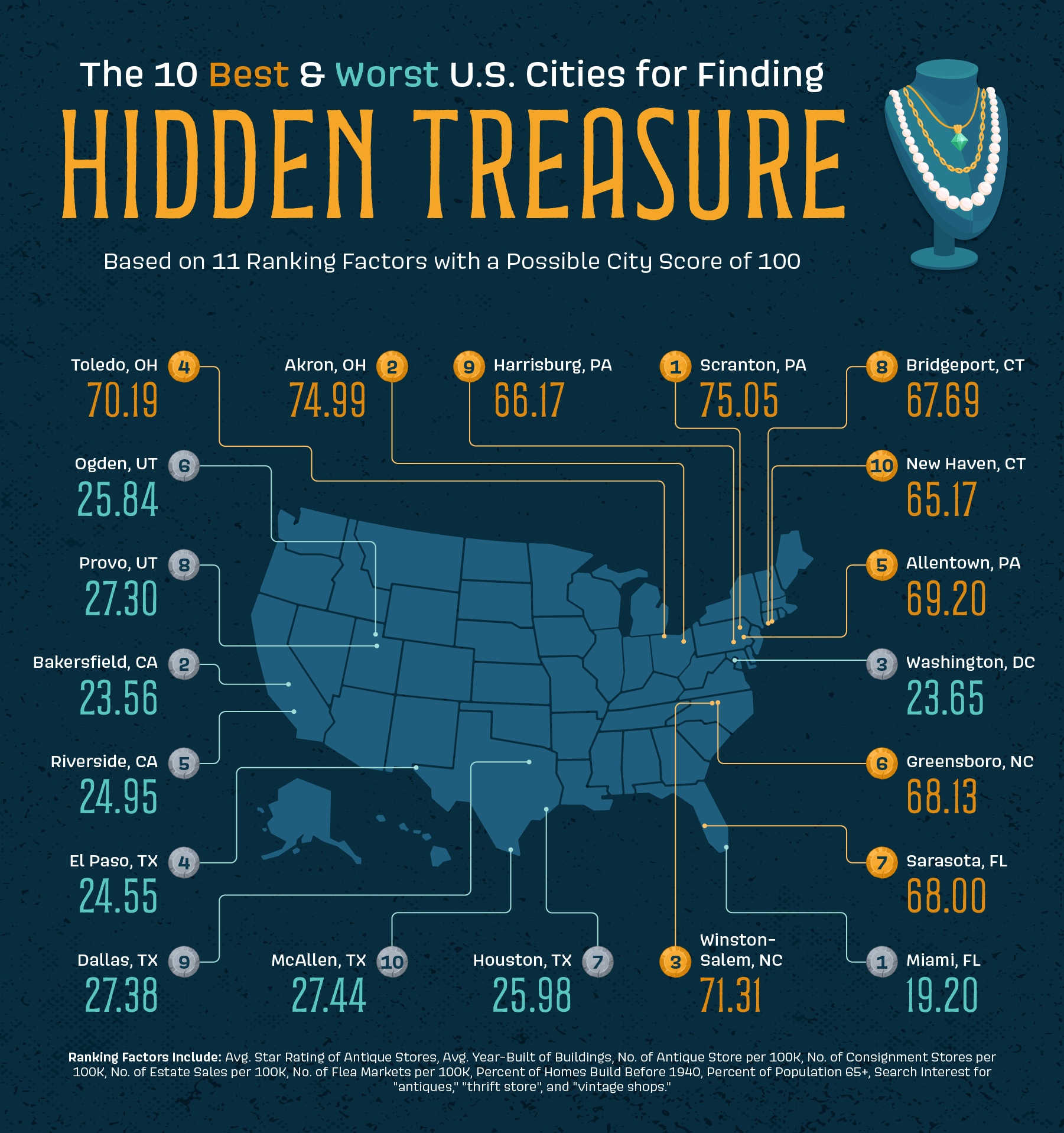
Scranton, PA — 75.1 out of 100
Scranton led the ranking because it checks nearly every box that matters for antique shoppers. It had one of the strongest showings for antique stores per capita, paired with a high share of older housing and strong search interest for “antiques near me.” That combination suggests both supply and demand. In a city with older homes and deep regional history, there are simply more opportunities for older pieces to stay in circulation.
Akron, OH — 75.0
Akron finished just behind Scranton, powered by standout density in several of the study’s most important categories. It scored especially well for antique stores, consignment shops, flea markets, and estate sales. That matters because a strong antiquing city usually offers more than one path to a find. Akron’s score reflects that kind of layered secondhand ecosystem.
Winston-Salem, NC — 71.3
Winston-Salem performed well because it combined strong antique shopping infrastructure with excellent estate-sale activity. That mix gives shoppers multiple ways to uncover older items, from curated storefront inventory to one-off household finds. Its placement also fits the city’s long-established character, with older neighborhoods helping support the kind of turnover that can fuel antique markets.
Toledo, OH — 70.2
Toledo’s strong finish came from balance across the board, and didn’t rely on a single standout factor. Instead, it posted solid numbers in the categories that mattered most, including antique-related business density, estate sales, and older infrastructure indicators. That kind of consistency helped push it into the top five.
Allentown, PA — 69.2
Allentown rounded out the top five thanks to a strong mix of older structures, antique availability, and supporting secondhand activity. Like Scranton, it benefits from being in a part of the country where older housing stock is more common, which can translate to more vintage and antique goods entering resale channels over time.
These top-ranked cities tended to do well for the same reason: they offered both access and context. The highest scorers weren’t just places with antique stores. They were places that offer a more consistent antique supply with more estate sales, more secondhand shopping options, stronger store ratings, and older environments that make antique hunting feel more connected to the city itself.
That also helps explain why so many top performers are concentrated in the eastern half of the country, where older buildings and longer-established resale markets are more common.
The Worst Cities for Antiquing
Miami, FL — 19.2 out of 100
Miami ranked last because it struggled in several of the study’s most heavily weighted categories. While it showed some interest-related strength, it scored poorly on core availability measures like antique stores, flea markets, and estate sales per capita. It also lacked the older housing profile that helped many top-ranked cities stand out.
Bakersfield, CA — 23.6
Bakersfield finished near the bottom because it didn’t show enough strength in the factors most closely tied to active antiquing markets. Lower store density, fewer estate sales, and weaker performance in older-housing measures made it harder to compete with cities where antique inventory appears to be more embedded in the local landscape.
Washington, DC — 23.7
Washington’s result is a reminder that wealth and history alone don’t guarantee a strong antiquing score. Despite the city’s age and cultural significance, it underperformed on the practical supply-side signals that mattered most in this study, including the per-capita availability of places to find antiques. In a dense, expensive market, the conditions that support broad antique access may simply be harder to maintain.
El Paso, TX — 24.6
El Paso landed near the bottom because it posted weaker numbers across several of the categories tied to antique-shopping access. Compared with the top cities, it had less support from the factors that create frequent opportunities for discovery, including antique store density and older infrastructure.
Riverside, CA — 25.0
Riverside also struggled to gain traction in the categories that shaped the overall ranking most. Its score suggests a thinner antiquing environment overall, with fewer signals of the kind of dense secondhand and estate-sale activity that helped lift cities at the top of the list.
The lowest-ranked cities generally fell short in the same areas where the leaders excelled. Many had lower per-capita access to antique, vintage, and other secondhand outlets, and they were often relatively newer cities, which can mean fewer older homes, fewer estate transitions tied to long-held household goods, and a thinner supply of antiques in circulation.
The best cities for antiquing tend to offer more than charm. They combine strong antique and resale infrastructure with the kind of age and turnover that can keep hidden treasures in play. Next, we’ll look at the cities that scored best in each individual factor to see which places stood out most in specific parts of the study.
Standout Cities For Antiquing: By the Numbers
A place doesn’t need to top the overall ranking for us to know it’s somewhere you can find hidden treasure. Some places stand out because they provide more outlets to find it with larger numbers of antique stores, estate sales, and other secondhand shops. Some because they’re cities with older infrastructure or or stronger local interest in vintage shopping. Looking at the top city for each factor helps show the different ways an antiquing destination can take shape.
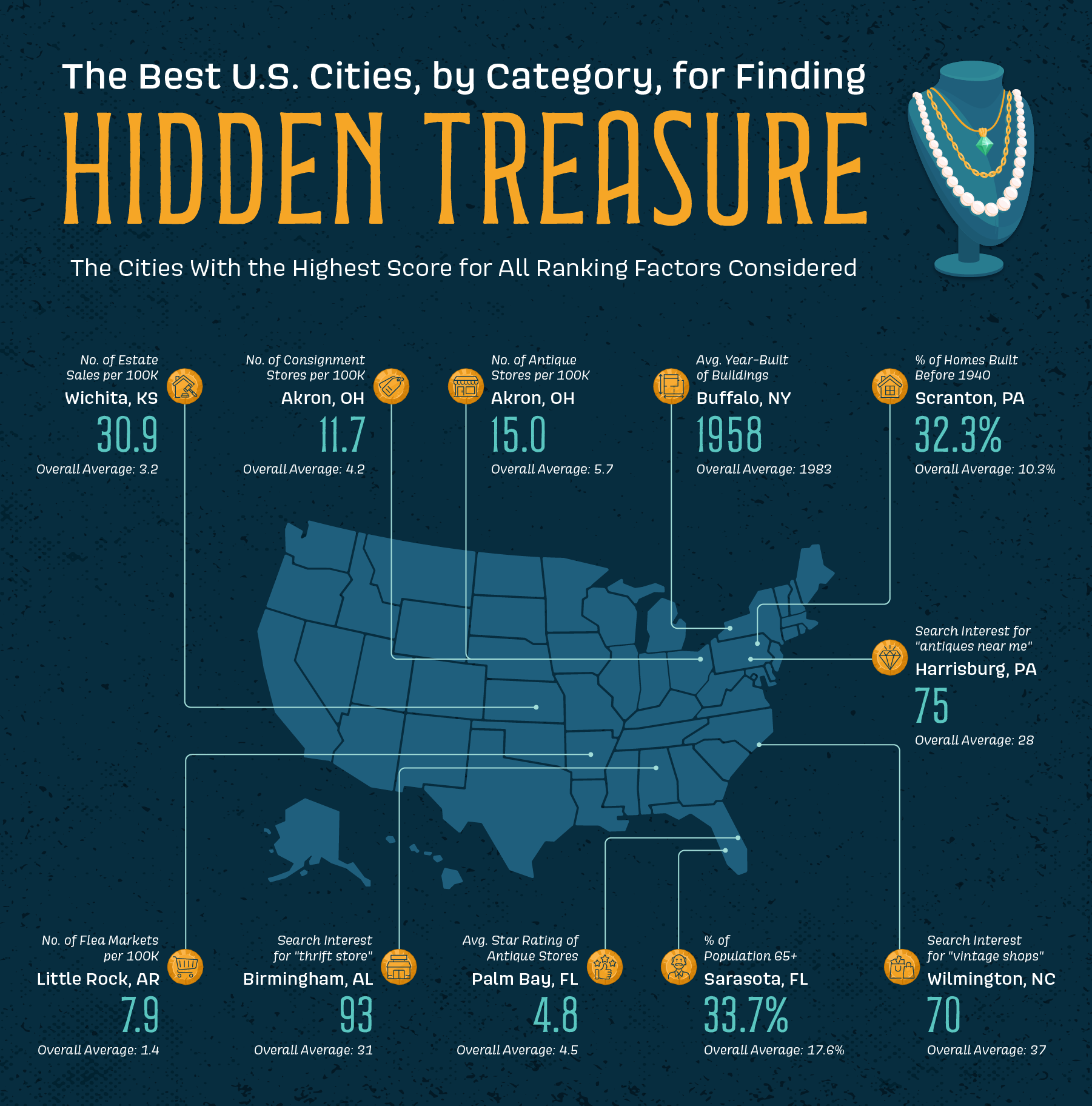
No. of antique stores per 100K: Akron, OH — 15.0
Study-wide average: 5.7
Akron had the highest concentration of antique stores in the study, with nearly 3 times the average. That helps explain why it placed so well overall. A high store count gives shoppers more variety, more inventory turnover, and better odds of finding something unexpected.
Avg. star rating of antique stores: Palm Bay, FL — 4.8
Study-wide average: 4.5
Palm Bay led the way in antique store ratings, suggesting shoppers there are finding stores they value for selection, service, or overall experience. Even in a study driven heavily by access and volume, quality still matters. Strong ratings can signal that a city’s antique scene is especially enjoyable to browse.
No. of flea markets per 100K: Little Rock, AR — 7.9
Study-wide average: 1.4
Little Rock stood far above the average for flea markets, offering one of the strongest signs of a thriving secondhand shopping culture. Flea markets often create a different kind of antiquing experience than dedicated shops, with more eclectic inventory and more room for surprise. Shoppers in Little Rock have no shortage of places to hunt.
No. of consignment stores per 100K: Akron, OH — 11.7
Study-wide average: 4.2
Akron appears again here, this time for consignment stores. In places where antique shops and consignment stores both run high, treasure hunters have more entry points into the resale market and more chances to come across older or distinctive pieces.
No. of estate sales per 100K: Wichita, KS — 30.9
Study-wide average: 3.2
Wichita posted one of the most striking numbers in the study, with estate sale density that came in nearly 10 times the average. Estate sales can be one of the clearest signals of real antiquing opportunity because they often bring older household items directly into the market. Wichita’s lead here suggests a city where treasure hunting may happen as much in driveways and living rooms as in storefronts.
Avg. year-built of buildings: Buffalo, NY — 1958
Study-wide average: 1983
Buffalo had the oldest average building stock in the study, and that kind of built history can matter for antique shopping. Older cities often have more longstanding neighborhoods, more generational turnover, and more chances for vintage items to remain in circulation. A lower average build year doesn’t guarantee a strong antique scene on its own, but it can help create the right conditions.
% of homes built before 1940: Scranton, PA — 32.3%
Study-wide average: 10.3%
Scranton led this factor by a wide margin, with nearly a third of homes built before 1940. That’s a major reason the city performed so well in the overall ranking. Older housing points to a longer material history, where furnishings, decor, and family possessions may have stayed in local circulation for decades.
% of population 65+: Sarasota, FL — 33.7%
Study-wide average: 17.6%
Sarasota had the highest share of residents age 65 and older, nearly double the study average. While this factor carried less weight than our access metrics, it still helps tell part of the story. Older populations can be tied to more downsizing, estate transitions, and household turnover, all of which can feed into local resale and antique markets over time.
Search interest for “antiques near me”: Harrisburg, PA — 75
Study-wide average: 28
Harrisburg posted the strongest interest in “antiques near me,” showing a level of local curiosity that far outpaced the average city in the study. That kind of search activity suggests antique shopping is top of mind for more residents there, which can help support stronger store ecosystems and more active local demand.
Search interest for “vintage shops”: Wilmington, NC — 70
Study-wide average: 37
Wilmington led the study in searches for “vintage shops,” pointing to a strong appetite for older and secondhand style. That doesn’t always mean formal antiques alone. It can also reflect broader interest in resale, retro design, and one-of-a-kind finds, all of which help shape a city’s shopping culture.
Search interest for “thrift store”: Birmingham, AL — 93
Study-wide average: 31
Birmingham’s search interest for “thrift store” was 3 times the study average, making it the clearest sign of strong local secondhand interest overall. Thrift isn’t the same as antiquing, but the two often overlap in meaningful ways. A city with high thrift interest may have a wider culture of reuse and treasure hunting, which can support antique shopping too.
Closing Thoughts
The best cities for antiquing aren’t just places with charming storefronts or older neighborhoods. They’re places where history, turnover, and local demand come together to create more chances of finding something worth holding onto. From antique stores and estate sales to decades-old homes and strong secondhand interest, the data shows that some cities offer far better odds for treasure hunters than others.
That idea also speaks directly to what makes antiquing so compelling in the first place. Hidden value often sits in plain sight, waiting for someone to recognize it. Whether it’s a vintage keepsake, an inherited piece of jewelry, or an overlooked item made with precious metals, old objects can still carry real financial and historical worth.
As a company that helps recover, refine, and preserve the value of precious metals, Elemetal operates in the same space where history meets opportunity. At a time when gold and silver prices have reached historic highs, the value tucked inside older items matters more than ever. Sometimes treasure hunting starts in an antique shop. Sometimes it starts by realizing what an old piece is really worth.
Methodology
To determine the cities you’re most likely to find hidden treasure, we ranked 100 of the largest U.S. cities based on factors that would be important for people who are looking for value in places you might not expect it.
We collected data on each city that relates to antique stores, vintage shops, estate sales, and the age of each city. We gave each of the 11 factors a weight based on their importance to derive a score based on how they compare across the cities in the study, and summed those individual scores to create a final total score metric.
A full list of factors considered, along with their weights and sources, can be found below:
| Ranking Factor | Source | Weight |
|---|---|---|
| No. of Antique Stores per 100K | Yellow Pages | 3.00 |
| Avg. Star Rating of Antique Stores | Google Reviews | 3.00 |
| No. of Flea Markets per 100K | Yellow Pages | 1.50 |
| No. of Consignment Stores per 100K | Yellow Pages | 1.50 |
| No. of Estate Sales per 100K | EstateSales.net | 3.00 |
| Avg. Year-Built of Buildings | U.S. Census Bureau | 1.00 |
| % of Homes Built Before 1940 | U.S. Census Bureau | 2.00 |
| % of Population 65+ | U.S. Census Bureau | 1.00 |
| Search Interest for “antiques near me” | Google Trends | 2.00 |
| Search Interest for “vintage shops” | Google Trends | 1.00 |
| Search Interest for “thrift store” | Google Trends | 1.00 |
Fair Use
You are welcome to use, reference, and share non-commercial excerpts of this study with proper attribution. If you cite or cover our findings, please link back to this page so readers can view the full methodology, charts, and context.