
Jewelry has long held a place in holiday gift-giving. A watch, necklace or ring can mark a relationship, reflect someone’s personal style and carry lasting value through the metals and gemstones that make it unique. But gifting the right piece often means balancing surprise with a recipient’s individual tastes.
To better understand how Americans approach holiday jewelry gifting, we surveyed 2,000 U.S. adults, with equal numbers of men and women. The survey explored the pieces, metals and gemstones people most want to receive, as well as their preferences around gift selection, spending and the value of precious materials. For the study, jewelry includes watches.
The results show what makes jewelry and watches appealing holiday gifts, where gift-givers see potential risks, and how people handle a piece that misses the mark. From gold and diamonds to surprise preferences and real gifting experiences, here’s what the data reveals about holiday jewelry gifting in 2026.
Holiday jewelry gifting by the numbers
- 56% of Americans want a holiday jewelry gift to be a complete surprise, while 25% would prefer to choose it together with the gift-giver.
- 87% of Gen Z women want jewelry as a holiday gift. Among Gen Z men, it’s 78%.
- Watches are the top holiday jewelry choice among men (58%), while necklaces rank first among women (29%).
- 65% of women and 40% of men have received jewelry they didn’t like or wouldn’t wear.
The jewelry Americans want most this holiday
Gifting jewelry over the holidays can be a heartfelt way to show you care. The right piece reflects someone’s personal style and when you find the perfect one to gift, it can make the occasion even more special.
Our survey found strong interest in receiving jewelry this holiday season, especially among younger adults, but the ideal gift looks different depending on who’s receiving it.
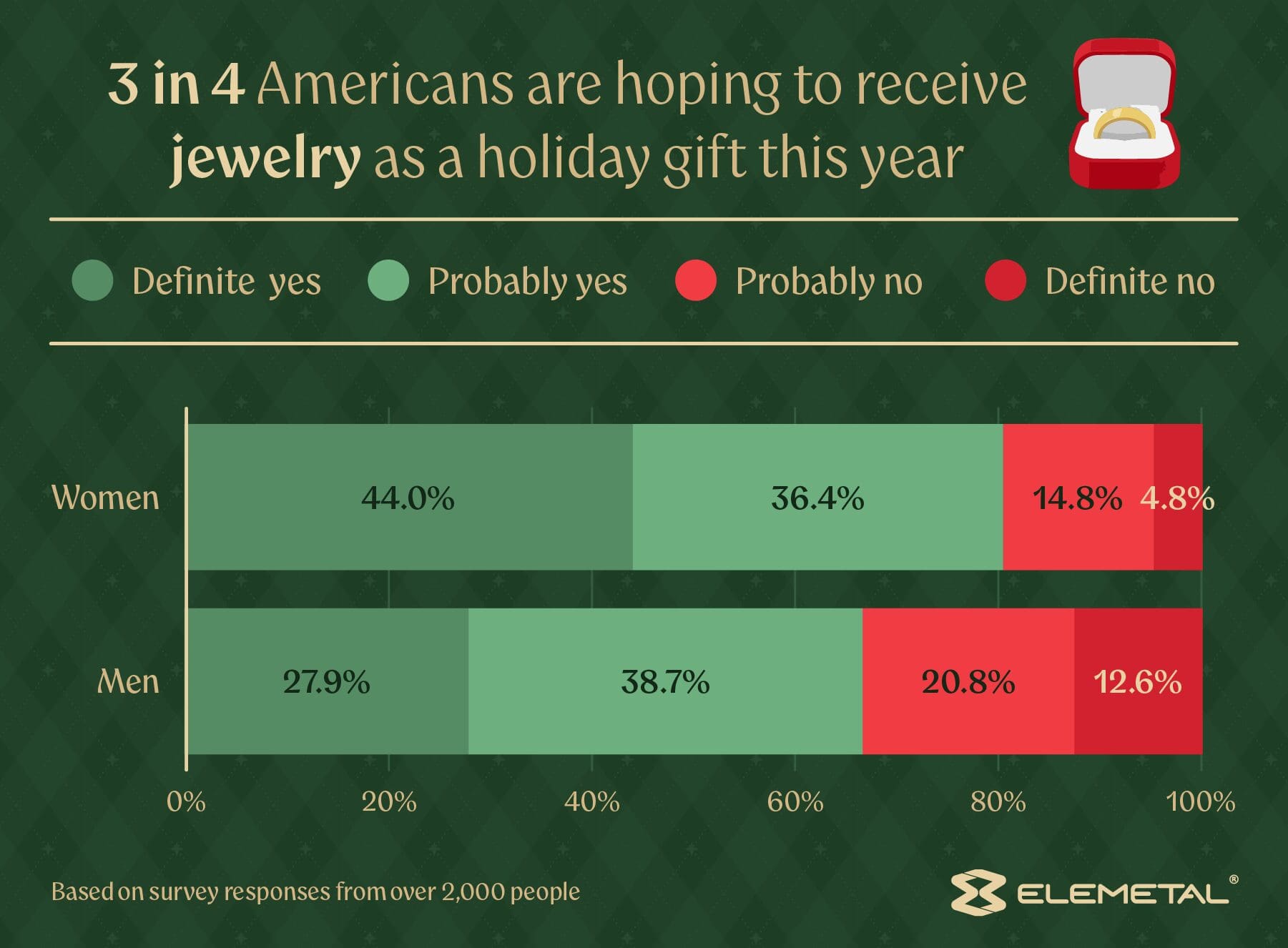
Younger adults show the strongest interest in jewelry
Women were especially likely to say they want jewelry for the holidays this year. Four in five women said they would like to receive it, including 44% who said they definitely would. Interest was also high among men, with two-thirds saying they would like to find jewelry under the tree this year.
That interest becomes even more pronounced among Gen Z respondents:
- 87% of Gen Z women said they would like jewelry as a holiday gift, compared with 66% of older women.
- 78% of Gen Z men said they would like jewelry or a watch, compared with 55% of older men.
The gap may reflect changing tastes, but it also points to the staying power of a well-chosen piece. Jewelry can become part of someone’s everyday style or a lasting marker of a particular occasion.
Women favor classic jewelry, while watches lead for men
The type of gift matters just as much as the idea of receiving one. Among women, necklaces ranked first, followed by rings and earrings. Men’s preferences leaned heavily toward watches.
- Women’s most-wanted pieces were necklaces (29%), rings (22%), and earrings (22%).
- Men’s most-wanted gifts were watches (58%) and necklaces or chains (17%).
For gift-givers, the findings underscore the importance of considering how a piece fits into the recipient’s existing style. A watch may be the clear choice for many men, while women’s preferences spread across several classic jewelry categories.
Gold remains the top metal choice
Yellow gold ranked as the most popular metal for both women and men, though other precious metals and materials also had broad appeal.
- Women most preferred yellow gold (25%), white gold (22%), sterling silver (19%), and rose gold (17%).
- Men most preferred yellow gold (21%), followed by sterling silver and white gold (15% each), then stainless steel (13%).
Diamonds also led gemstone preferences for both groups. Among women, 39% selected diamonds, followed by sapphires (10%) and emeralds (9%). Among men, diamonds led at 30%, while black onyx (9%) and emeralds (8%) followed. Still, nearly three in ten men said they would prefer a piece without gemstones.
A successful holiday jewelry gift starts with more than choosing something that looks impressive. The style, metal and details all shape whether a piece feels personal. Next, we’ll look at what Americans want from the experience of receiving jewelry as a gift.
What Americans want from a holiday jewelry gift
Knowing which pieces, metals and gemstones someone prefers is a useful starting point. But a holiday jewelry gift also comes with another set of decisions: Should it be a surprise? Does the material value matter? And is it worth the risk of getting someone’s taste wrong?
We found that many Americans still want the excitement of an unexpected gift, even as their responses reveal why choosing one can feel complicated.
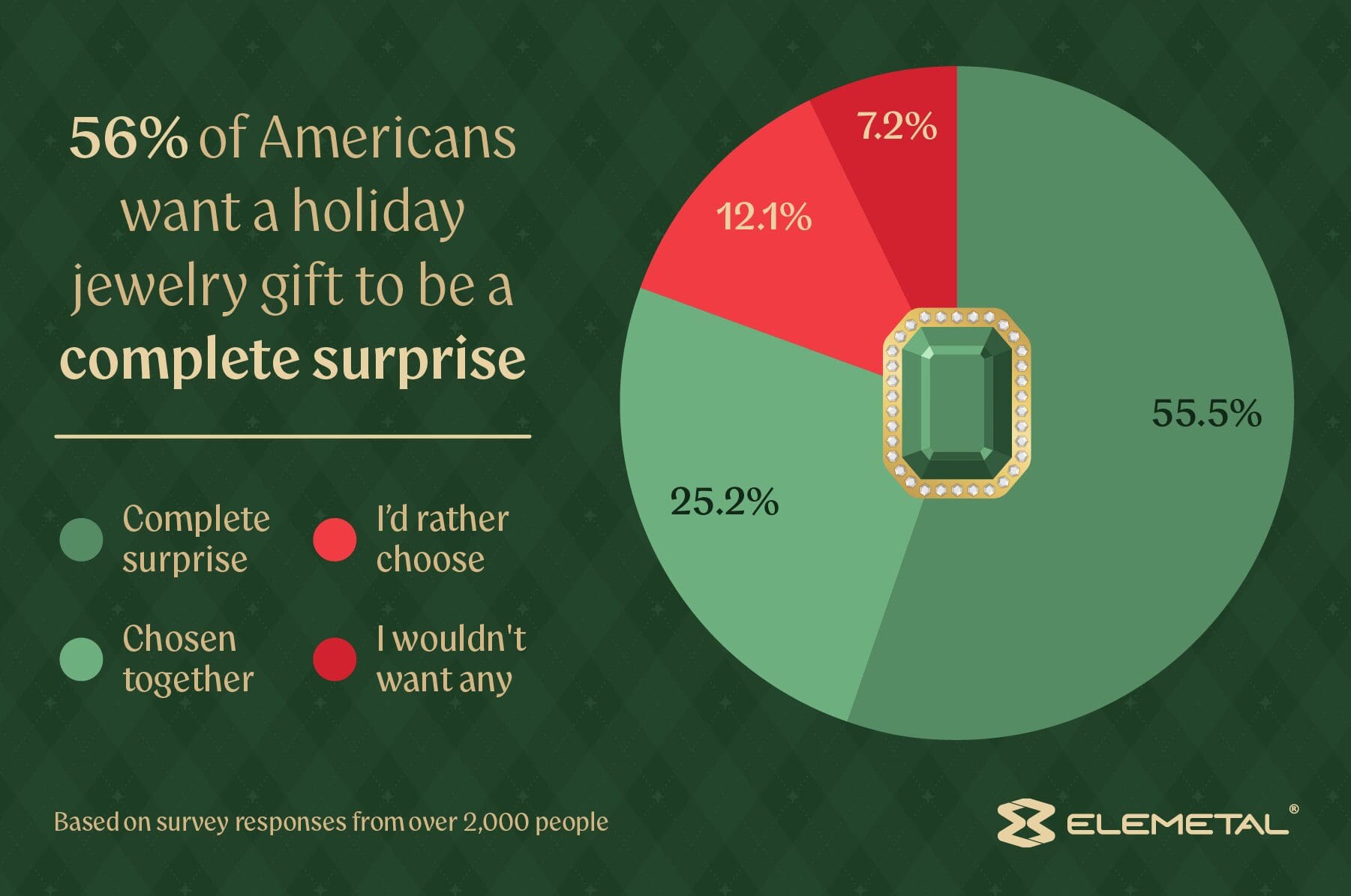
Most people still want a surprise
56% of respondents said they would want a holiday jewelry gift to be a complete surprise. Another 25% would rather choose the piece together with the gift-giver.
That result held relatively steady across men and women. It suggests that, for many people, the surprise is part of what makes jewelry feel special. At the same time, the one-quarter who prefer a shared decision shows that collaboration can be the better route when a recipient’s style or preferences are less clear.
Precious materials add appeal, but cash still wins for many
The metal and gemstones in a piece can influence how recipients view it. Nearly seven in ten women (68%) and men (67%) said knowing a gift contains precious metals or valuable gems makes it more appealing.
The findings also show that while they prefer high-value jewelry, many Americans would rather have a cash boost than jewelry with the same price tag
- Two-thirds of women said they would rather receive $500 in cash than a $500 piece of jewelry from a significant other.
- Seven in ten men said the same.
That contrast highlights the difference between a gift’s monetary value and its personal value. Yellow gold, diamonds, and other enduring materials can make a piece more appealing, but they don’t guarantee that it will be the preferred choice for every recipient.
Gift-givers see the risk, but many still plan to give jewelry
The possibility of missing the mark is clearly on people’s minds. More than one-third of women (36%) and men (39%) said giving jewelry to a romantic partner feels at least somewhat risky.
Even so, jewelry remains part of many holiday plans:
- 36% of women in relationships said they plan to give someone jewelry this holiday season.
- 48% of men in relationships said the same.
There’s a balancing act behind a holiday jewelry purchase. A surprise can make the gift memorable, and precious materials can add to its appeal, but personal taste still shapes how it will be received. Next, we’ll look at Americans’ real experiences giving and receiving jewelry, including what happens when a gift doesn’t quite fit the recipient.
When a jewelry gift misses the mark
A thoughtful gift doesn’t always become a favorite. We found that receiving unwanted jewelry is a common experience, and that recipients and gift-givers often have different ideas about what should happen next.
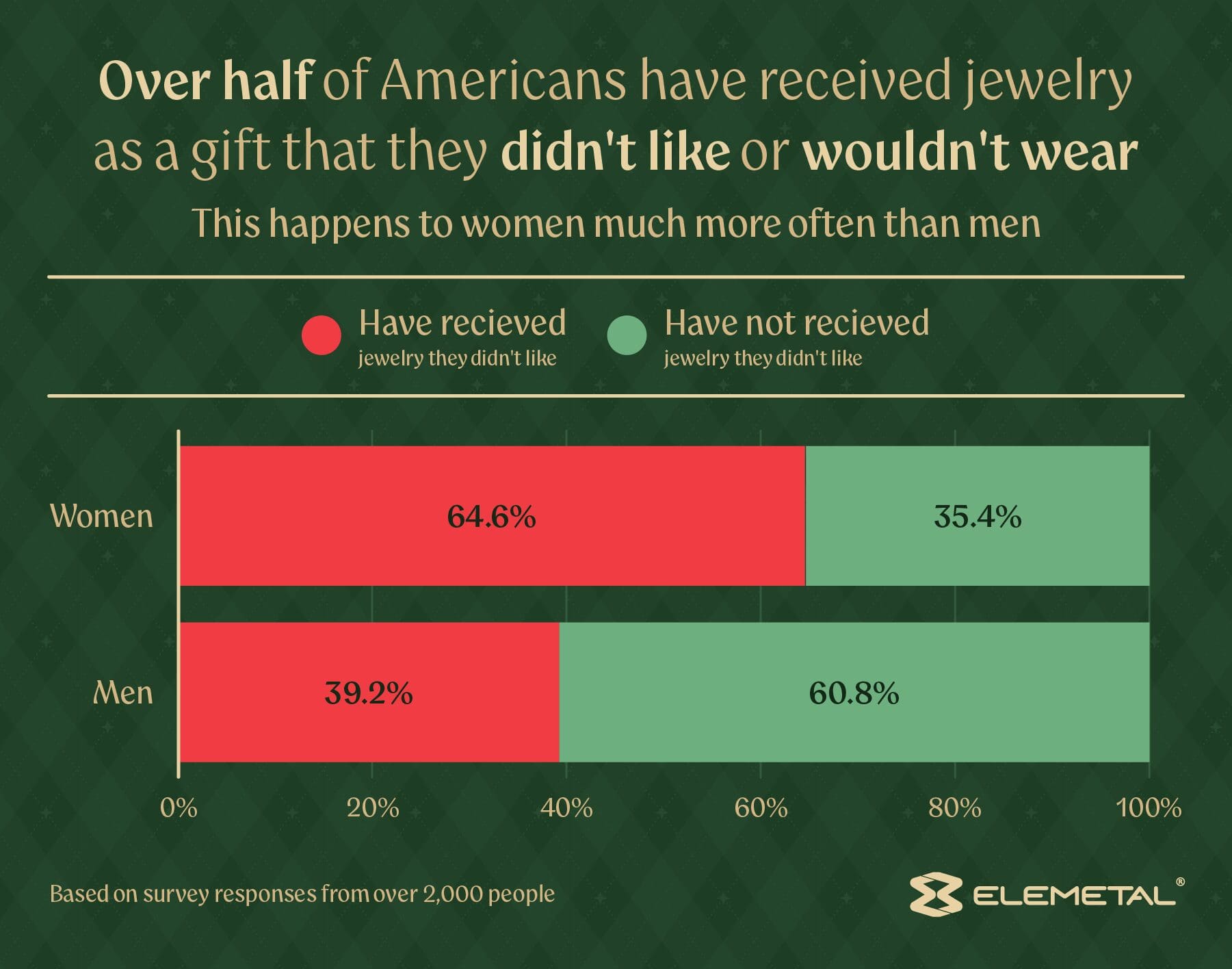
Unwanted jewelry is more common than gift-givers may expect
Many respondents said they have received jewelry they didn’t like or wouldn’t wear. Women were more likely to report that experience than men, though it affected a substantial share of both groups:
- 65% of women said they have received jewelry they didn’t like or wouldn’t wear.
- 40% of men said the same about jewelry.
Gift-givers have encountered the issue, too. 30% of women and 35% of men said they have given someone a jewelry gift that person didn’t like.
The response can carry real emotional weight. Two-thirds of women (67%) and 61% of men said they would be hurt if someone didn’t like the jewelry they gave.
What people say they want differs from what often happens
When asked about the best way to handle a nice piece of jewelry from a romantic partner that they don’t like, women and men offered slightly different answers.
- Women most often said the recipient should wear it occasionally to avoid hurting the giver’s feelings (47%). One-third said they should be honest and exchange or return it (33%).
- Men most often said the recipient should be honest and exchange or return it (41%), closely followed by wearing it occasionally to avoid hurting the giver’s feelings (39%).
- For both women and men, 10% said the recipient should keep the piece but explain that they would like more input next time.
Only a small share said they exchanged or returned the piece—10% of women and 14% of men.
In practice, however, many people who have received an unwanted jewelry gift have chosen a quieter path. Among women and men who had received a piece they didn’t like, 42% said they kept it but barely wore it. Another 35% in each group said they wore it occasionally to avoid hurting the giver’s feelings.
If a piece is no longer being worn, its value can extend beyond its original design. Jewelers, pawn shops, and estate buyers can evaluate whether it can be resold, repurposed, or sent for refining. Elemetal works with these trade partners to refine scrap jewelry made of gold, silver, platinum, and palladium. For pieces with gemstones, Elemetal also offers stone removal so the stones and metals can be evaluated separately.
The value behind a thoughtful gift
Holiday jewelry gifting sits at the intersection of surprise, personal style and lasting value. We see that many Americans welcome the idea of a meaningful piece, but the details do matter—from the metal and gemstone to whether the recipient has a say in the selection.
A well-chosen watch or piece of jewelry can become part of someone’s everyday life. And when a piece no longer fits a person’s style or needs, its precious metals can still hold value beyond its original form.
“Jewelry can outlast the holiday moment it was bought for, whether it’s a trend that fades in the new year or a gift from an ex,” said Zachary Zajicek, brand marketing manager at Elemetal. “Even then, its precious metals can still hold value. Refining recovers those materials for future use, giving jewelers a way to find value in unwanted or outdated pieces.”
At Elemetal, we see that value every day. For jewelers, pawn shops, and estate buyers, a piece that no longer suits its owner may still hold value in both its precious metals and gemstones. Stone removal helps separate diamonds and gemstones from gold and platinum jewelry, allowing each component to be evaluated for its next purpose.
Methodology
To better understand how Americans approach holiday jewelry gifting in 2026, we surveyed 2,000 U.S. adults, including equal populations of men and women.
The survey explored the types of jewelry and watches people most want to receive during the holidays, including their preferred metals, gemstones, and styles. Respondents were also asked whether they prefer a surprise or more input when receiving jewelry, how much they expect a romantic partner to spend, and whether the value of precious metals and gemstones affects a gift appeal.
The survey also examined Americans’ experiences giving jewelry and watches as gifts, including whether they view the purchase as risky and how they believe recipients should handle a piece they do not like.
The survey ran for one week in October 2026.
Fair Use
You are welcome to use, reference, and share non-commercial excerpts of this study with proper attribution. If you cite or cover our findings, please link back to this page so readers can view the full methodology, charts, and context.